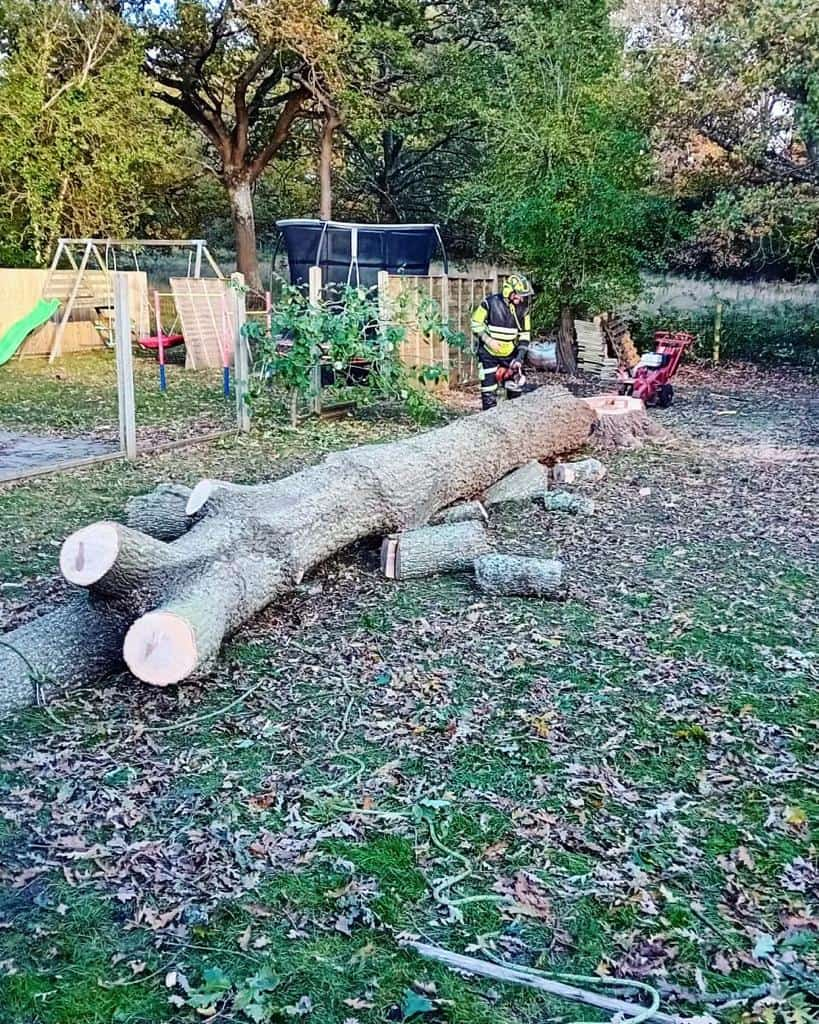
Trees are constantly developing. Branches extend, crowns become larger, deadwood can appear and the relationship between a tree and its surroundings can change considerably over time. A tree that fitted comfortably within a garden when it was younger may eventually require professional management as it matures.
For property owners in Sawbridgeworth, Hertfordshire, tree surgery can play an important role in managing this gradual change. Rather than waiting until a tree becomes excessively large or develops an obvious problem, appropriate assessment and proportionate pruning can help maintain suitable growth, structure and clearance over the longer term.
Effective tree management is not about repeatedly cutting trees simply to keep them small. It involves understanding what each tree requires, identifying problems at the appropriate stage and choosing tree surgery that supports sensible future development.
How Does Professional Tree Surgery Support Long-Term Tree Management?
Professional tree surgery provides a planned way of managing trees as they grow and change.
Depending on the individual tree, this may involve selective pruning, crown reduction, crown lifting, deadwood removal or other carefully considered work. In some circumstances, a tree may need very little intervention beyond periodic assessment.
The important point is that tree surgery should respond to an actual requirement. When work is carried out for a clear reason and with future growth in mind, it can help avoid a cycle of unnecessarily severe pruning.
Trees Change as They Mature
A tree is not a fixed feature within a garden.
Its canopy can become wider and taller, individual branches can become increasingly substantial, and the amount of space occupied by the tree can change considerably.
These developments may happen gradually enough that they are difficult to notice from day to day.
Long-term tree management considers how the tree is developing rather than waiting until its size becomes difficult to accommodate.
This provides an opportunity to address specific growth at a more manageable stage.
Regular Assessment Helps Identify What Has Changed
Tree management should begin with observation and assessment rather than automatic pruning.
A professional tree surgeon can examine the tree’s overall form, crown, major branches, visible trunk and surrounding environment.
Changes may include:
- Increasing crown spread
- Overextended branches
- Developing deadwood
- Low branches reducing clearance
- Dense or unbalanced growth
- Previously pruned areas producing new shoots
- Branches beginning to interfere with garden use
- Changes in the general condition of the tree
Identifying these developments provides a clearer basis for deciding whether tree surgery is actually required.
Not Every Tree Needs Regular Cutting
Long-term management does not mean pruning every tree frequently.
Some established trees may require relatively little intervention when they have sufficient space and suitable structure.
Unnecessary pruning can remove healthy growth without providing a meaningful benefit.
Professional assessment helps distinguish between a tree that genuinely requires work and one that can simply continue developing.
This proportionate approach is an important part of responsible tree management.
Early Pruning Can Prevent Growth Becoming More Difficult to Manage
Small branches are generally easier to manage than substantial mature limbs.
Where a branch is clearly developing in an undesirable direction or beginning to occupy an unsuitable area, addressing it at an appropriate stage can sometimes avoid more extensive work later.
Allowing problematic growth to continue for many years may eventually mean that considerably larger branches need attention.
Long-term management therefore focuses not only on what the tree looks like today but also on how existing growth is likely to develop.
Selective Pruning Can Address Specific Branches
Not every tree requires its entire crown to be reduced.
Sometimes one or two branches create the main concern.
An overextended limb may project across a frequently used part of the garden, or a particular branch may have become damaged while the remainder of the canopy remains suitable.
Selective pruning concentrates on these specific areas.
This retains more of the established canopy and avoids unnecessary intervention elsewhere.
Crown Reduction Can Manage Excessive Size
As some trees mature, their overall dimensions may become increasingly difficult to accommodate within the available space.
Where appropriate for the species and condition of the tree, crown reduction can decrease the height, spread or overall dimensions of the canopy.
Branches are shortened back to suitable growth points while maintaining a balanced structure.
Crown reduction can therefore form part of a longer-term management strategy for trees that remain suitable for retention but require their dimensions to be controlled.
Crown Reduction Should Be Proportionate
Removing more canopy does not necessarily provide a better result.
Heavy reduction can create a dramatic change and may encourage vigorous regrowth in some trees.
A proportionate crown reduction seeks to achieve the required improvement while retaining suitable foliage and branch structure.
This is particularly important when thinking about future maintenance.
A tree that has been carefully reduced can be monitored as new growth develops, rather than repeatedly subjected to unnecessarily severe cutting.
Crown Lifting Can Maintain Useful Clearance
Lower branches can gradually extend into areas where greater clearance is desirable.
Where appropriate, crown lifting involves managing selected lower branches to increase the usable space beneath the canopy.
This can be useful around paths, lawns and other frequently used parts of a garden.
The objective is not to remove every lower branch. Excessive lifting can alter the proportions of the tree.
Professional judgement is therefore important when deciding how much clearance is appropriate.
Deadwood Management Can Form Part of Ongoing Care
Trees can naturally develop dead branches.
The presence of some deadwood does not automatically mean the whole tree is in poor condition.
However, significant dead branches may require attention depending on their size and position.
Professional assessment can identify deadwood and determine whether removal is appropriate as part of ongoing tree maintenance.
This targeted approach avoids confusing dead branches with healthy growth that does not need to be removed.
Damaged Branches Should Be Assessed in Context
Branches can become damaged for various reasons, including adverse weather or mechanical damage.
A broken branch does not automatically indicate a problem with the complete tree.
Where the damage is localised, removing or appropriately pruning the affected limb may be sufficient.
However, repeated damage across several substantial branches may justify assessment of the wider crown and structure.
Looking at the complete tree helps determine whether an isolated repair or broader management is required.
Managing Overextended Branches Can Preserve Garden Space
Individual branches can gradually extend well beyond the main canopy.
In a garden, these limbs may eventually occupy useful space or create unwanted encroachment around established features.
Appropriate reduction of selected branches can bring the canopy back into better proportion.
Addressing this growth before it becomes excessively substantial can make future management more straightforward.
Long-Term Management Can Help Trees Remain Suitable for Their Position
A tree can be healthy while still becoming increasingly difficult to accommodate.
The issue may simply be that the tree’s natural development is beginning to exceed the available garden space.
Professional tree surgery can sometimes manage this relationship successfully.
By controlling particular areas of growth and maintaining appropriate clearance, a suitable tree may continue to be retained rather than removal becoming the first response to excessive size.
Good Tree Surgery Can Help Avoid Unnecessary Felling
A tree that has become large is not automatically a tree that needs to be removed.
If the main concern involves excessive crown spread, low branches or particular overextended limbs, pruning may provide a more proportionate solution.
Professional assessment is valuable because it identifies whether retention remains realistic.
Where appropriate tree surgery can resolve the problem, felling may be unnecessary.
Where the tree’s condition or circumstances make continued management unsuitable, removal can then be considered on the basis of the complete situation.
Previous Pruning Influences Future Growth
Once a tree has been pruned, its subsequent development can be influenced by that work.
Some trees produce vigorous shoots around previous pruning points. Others may develop a denser crown or altered branch structure.
Future tree surgery should therefore consider what has happened previously.
Repeatedly making the same cuts without examining the resulting growth can lead to an ongoing cycle of heavy pruning.
Long-term management should adapt according to how the tree has responded.
Poor Previous Pruning May Need Careful Management
Trees that have previously been cut back severely can sometimes develop complicated regrowth.
Numerous shoots may emerge from old pruning points, creating dense sections within the canopy.
Attempting to correct this immediately through another severe reduction may not provide the best result.
A professional tree surgeon can assess the current structure and determine how future work should be approached.
In some situations, gradual management may be more appropriate than trying to transform the tree during a single visit.
Tree Surgery Should Consider Future Regrowth
One of the most important parts of professional pruning is recognising that the tree will continue growing afterwards.
The finished appearance immediately after tree surgery is only one part of the outcome.
The remaining branches provide the framework from which future growth develops.
Suitable pruning points, balanced branch selection and proportionate canopy removal all influence how manageable the tree is likely to be as it grows again.
Severe Pruning Is Not a Substitute for Planned Management
Waiting until a tree has become extremely overgrown and then cutting it back heavily can create an avoidable cycle.
Large amounts of canopy may need removing, followed by vigorous regrowth that eventually requires further intervention.
A more considered approach is to assess the tree periodically and carry out appropriate work when there is a clear reason.
This can allow individual problems to be addressed without repeatedly making dramatic changes to the whole tree.
Different Species Require Different Approaches
Trees do not all grow or respond to pruning in the same way.
Their natural crown shapes, growth rates and reactions to branch removal can vary considerably.
This is why long-term tree management should be specific to the individual tree.
Applying the same pruning specification to every tree ignores these differences.
Professional tree surgery considers the characteristics of the tree before deciding what work is appropriate.
The Tree’s Age and Condition Matter
A young tree with relatively small branches requires a different approach from a mature tree containing substantial limbs developed over many years.
Condition is equally important.
A healthy tree with excessive growth presents a different situation from one containing extensive deterioration.
Professional assessment considers age, condition and structure together rather than making decisions based solely on size.
Tree Surgery Can Help Maintain a Balanced Crown
Tree crowns do not always develop evenly.
Branches may grow more strongly in particular directions because of available space and surrounding conditions.
Over time, one section of the canopy can become noticeably more prominent.
Where appropriate, selective pruning can help manage overextended growth while retaining the natural character of the tree.
The aim is not artificial symmetry but a suitable and proportionate crown.
Garden Changes Can Affect Tree Management
The surroundings of a tree can change even when the tree itself has not developed a problem.
A garden may be redesigned, paths may be repositioned or previously unused areas may become more frequently occupied.
These changes can affect how the existing tree interacts with the available space.
Branches that previously caused no inconvenience may begin restricting a newly used part of the garden.
Tree management therefore needs to consider both the tree and how its surroundings are being used.
Several Trees Should Be Considered Together
Where a garden contains multiple established trees, their crowns can eventually begin overlapping.
Managing each tree independently without considering the others may produce an unbalanced result.
Professional assessment can look at how the trees relate to one another and identify which areas genuinely require attention.
One tree may need crown reduction, another may only require selective pruning, while a third may need no work.
This coordinated approach can provide better long-term results than treating every tree identically.
Tree Felling Has a Place in Long-Term Management
Good tree management is not solely about preserving every tree indefinitely.
There are circumstances where removal becomes the appropriate option.
A tree may deteriorate significantly, become unsuitable for its position or reach a point where repeated substantial intervention no longer provides a satisfactory outcome.
Where felling is considered, the decision should be based on assessment rather than simply on the tree being large or inconvenient.
Professional tree surgery helps establish when continued management is realistic and when removal deserves consideration.
Stump Management Completes the Process Where Trees Are Removed
When a tree does need to be felled, the remaining stump can influence how the area is used afterwards.
Stumps may interfere with lawns, planting areas, paths or future garden improvements.
Stump grinding can reduce the main obstruction and make the area easier to incorporate into the wider garden.
Considering stump treatment alongside tree removal provides a more complete approach to managing the site.
Planned Tree Management Can Reduce Reactive Work
Reactive tree surgery often begins when a problem has already become obvious.
A branch may have become excessively large, a crown may dominate the available space or repeated regrowth may have created another maintenance issue.
Planned management takes a different approach.
Periodic assessment can identify developing concerns and determine whether modest intervention would be beneficial.
This does not mean carrying out unnecessary work. It means making decisions before manageable growth develops into a more complicated problem.
Professional Assessment Provides a Clearer Management Plan
Long-term tree care benefits from understanding what each tree actually requires.
A professional assessment may consider:
- The species and natural growth habit
- Overall tree condition
- Crown size and structure
- Dead or damaged branches
- Overextended limbs
- Previous pruning and subsequent regrowth
- Clearance around garden features
- Available growing space
- The relationship with neighbouring trees within the garden
- Whether intervention is currently necessary
- How the tree is likely to develop after pruning
This information allows tree surgery to be based on actual requirements rather than assumptions.
The Best Management May Sometimes Be to Leave the Tree Alone
Professional tree surgery also involves recognising when pruning is unnecessary.
If a tree is healthy, has suitable structure and has sufficient space to develop, intervention may provide little practical benefit.
Leaving suitable growth untouched preserves the established canopy and avoids unnecessary pruning wounds.
Long-term management is therefore not measured by how often a tree is cut. It is measured by whether the right decisions are made as the tree develops.
Professional Tree Surgery in Sawbridgeworth, Hertfordshire
At Sawbridgeworth Tree Surgeons, we approach tree surgery with the individual tree and its future development in mind.
Whether a tree requires selective pruning, crown reduction, crown lifting, deadwood management or simply assessment depends on its condition, structure and relationship with the surrounding garden.
For property owners in Sawbridgeworth, Hertfordshire, professional tree surgery can provide a practical way to manage established trees as they mature, helping to address developing problems without carrying out more work than the tree genuinely requires.
Conclusion
Tree surgery is important for long-term tree management because trees continually grow and change. Branches extend, crowns become larger, previous pruning produces new growth and the relationship between a tree and its surroundings can gradually become more complicated.
Appropriate tree surgery allows these changes to be managed proportionately. Selective pruning can address individual branches, crown reduction can manage excessive dimensions, crown lifting can maintain useful clearance, and deadwood removal can deal with specific areas requiring attention.
Just as importantly, professional assessment can establish when no pruning is necessary or when a different approach should be considered.
If you have established trees in Sawbridgeworth, Hertfordshire and would like to understand how they should be managed over the longer term, contact Sawbridgeworth Tree Surgeons. We can assess their condition and development and recommend appropriate tree surgery based on what each tree actually requires.
Call us on: 01279 967 990
Click here to find out more about Sawbridgeworth Tree Surgeons
Click here to complete our contact form and see how we can help with your tree care needs.